
CNC Machining Stainless Steel — Custom Precision Parts
Get instant quotes on custom CNC-machined stainless steel parts for prototypes, small batch, and mass production. ISO 9001:2015 certified. Tolerance ±0.01 mm. Delivery in 5–7 working days from Krsnaye Industrial P. Ltd.
What is CNC Machining Stainless Steel?
Understanding the material, the challenges, and why choosing the right partner matters.
Stainless steel is defined as a steel alloy containing a minimum of 10.5% chromium — the element that forms a passive, self-repairing oxide layer on the surface and gives the material its characteristic corrosion resistance. Most machining-grade stainless steels also contain nickel (8%+) and, in specialty grades, molybdenum, titanium, copper, or niobium to tune properties for specific environments.
Stainless steels are used where strength, corrosion resistance, and cleanliness all matter simultaneously — from aerospace fasteners and medical surgical instruments to food-grade valves and offshore hardware. Unlike mild steel, stainless parts typically do not require plating or paint, which reduces lifetime maintenance cost.
At Krsnaye Industrial, we CNC machine stainless steel on dedicated turning and milling centres tuned for this material. Our operators are trained to manage stainless-specific challenges — work hardening, chip control, heat build-up — so that your parts come out within tolerance, finish the first time, and ship on schedule.
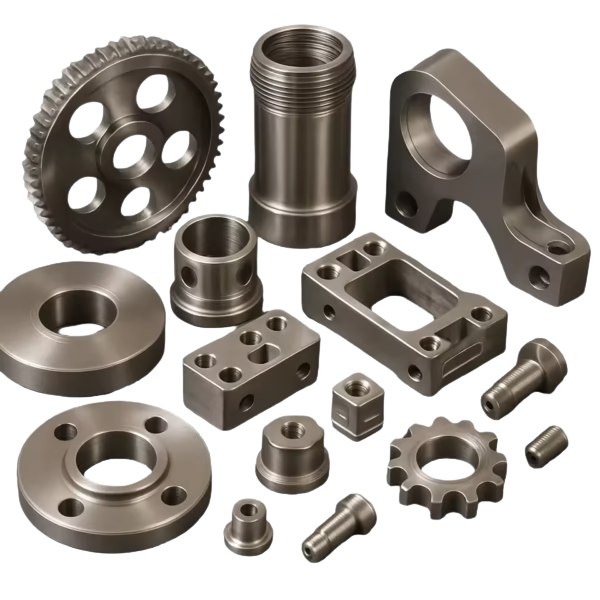 Image placeholder — CNC stainless steel part (800×600)
Why Stainless Steel is Difficult to Machine — and How We Solve It
- Work hardening: stainless rapidly hardens under cutting load, dulling tools. We use sharp-edged carbide inserts and aggressive feed rates to cut beneath the hardened layer.
- High cutting forces: large deformation requires rigid setups. We use heavy-duty fixtures and minimal overhang to control deflection.
- Poor chip breaking: stringy, tough chips can scratch surfaces. We use chip-breaker geometries and high-pressure coolant.
- Heat concentration: low thermal conductivity traps heat at the tool tip. We run flood coolant with correct cutting parameters to keep tools alive.
- Tool wear: hardness and abrasion rapidly wear standard tooling. We use coated carbide and, for high-volume 17-4PH and 440C, ceramic inserts.
- Surface finish: built-up edge degrades Ra. We use controlled cutting speeds and finishing passes with fresh inserts for critical surfaces.
Benefits of CNC Machining Stainless Steel
Why engineers across industries specify stainless steel for precision parts.
Superior Corrosion Resistance
Chromium oxide passivation layer protects against rust, acids, salt spray, and chemical attack — ideal for marine, chemical, and medical environments.
High Strength & Hardness
Tensile strength of 500–1400 MPa depending on grade and heat treatment. Precipitation-hardened grades like 17-4PH reach HRC 40+ after ageing.
High-Temperature Performance
Grades like 316 retain strength and corrosion resistance up to 870°C continuous service. Oxidation-resistant up to 925°C intermittent.
Hygienic & Food-Safe
Non-porous, easily sterilised surfaces. 304 and 316 meet FDA, NSF, and EU food-contact standards without coating or plating.
Aesthetic Finish
Natural lustre that can be polished, brushed, bead-blasted, or passivated. No paint or plating required for a premium appearance.
Fully Recyclable
100% recyclable without loss of properties. Most stainless steel globally is produced from recycled content — a genuinely sustainable engineering material.
Stainless Steel Grades We Machine
We stock and machine the most widely specified grades. All material supplied with mill test certificates on request.
Stainless Steel 303
UNS S30300 · 1.4305 · SUS303 · Y1Cr18Ni9Free-machining austenitic stainless steel with added sulphur for improved machinability — up to 50% faster cutting than 304 with cleaner chips and better tool life. The preferred grade for high-volume CNC turning of shafts, bushings, and threaded components where corrosion resistance matters but weldability does not.
Chemical Composition (%)
| C | Si | Mn | P | S | Cr | Ni |
|---|---|---|---|---|---|---|
| ≤0.15 | ≤1.00 | ≤2.00 | ≤0.20 | ≥0.15 | 17.0–19.0 | 8.0–10.0 |
Mechanical Properties
- Tensile Strength≥ 520 MPa
- Yield Strength (0.2%)≥ 205 MPa
- Elongation≥ 40%
- Hardness≤ 187 HB
- Density7.93 g/cm³
- Machinability78% (AISI 1212 = 100%)
Stainless Steel 304 / 304L
UNS S30400 / S30403 · 1.4301 / 1.4307 · SUS304 · 18-8The world's most widely used stainless steel — accounting for over 50% of global stainless production. Excellent corrosion resistance in atmospheric, freshwater, and mild chemical environments, combined with good formability and weldability. The 304L low-carbon variant (≤0.03% C) avoids carbide precipitation during welding, making it preferred for welded assemblies.
Chemical Composition (%)
| C | Mn | P | S | Cr | Ni |
|---|---|---|---|---|---|
| ≤0.08 | ≤2.00 | ≤0.045 | ≤0.030 | 18.0–20.0 | 8.0–10.5 |
Mechanical Properties
- Tensile Strength515–750 MPa
- Yield Strength (0.2%)≥ 205 MPa
- Elongation≥ 40%
- Hardness≤ 201 HB
- Density7.93 g/cm³
- Melting Point1400–1455 °C
- Max Service Temp870 °C
Stainless Steel 316 / 316L
UNS S31600 / S31603 · 1.4401 / 1.4404 · SUS316 · Marine GradeThe benchmark for corrosion resistance in aggressive environments. The addition of 2–3% molybdenum dramatically improves resistance to pitting and crevice corrosion from chlorides, making 316 the default grade for marine, pharmaceutical, and chemical processing applications. 316L with reduced carbon (≤0.03%) is preferred for welded construction to avoid sensitisation.
Chemical Composition (%)
| C | Mn | Cr | Ni | Mo |
|---|---|---|---|---|
| ≤0.08 | ≤2.00 | 16.0–18.0 | 10.0–14.0 | 2.0–3.0 |
Mechanical Properties
- Tensile Strength≥ 515 MPa
- Yield Strength (0.2%)≥ 205 MPa
- Elongation≥ 40%
- Hardness≤ 217 HB
- Density7.99 g/cm³
- Max Service Temp925 °C
Stainless Steel 420
UNS S42000 · 1.4028 · SUS420J2 · 3Cr13Martensitic stainless steel that can be heat-treated to HRC 48–55 for applications demanding both corrosion resistance and wear resistance. Commonly used for cutlery, surgical instruments, valve parts, pump shafts, and tooling where moderate corrosion resistance combined with high hardness is required.
Chemical Composition (%)
| C | Mn | Cr | Ni |
|---|---|---|---|
| 0.16–0.25 | ≤1.00 | 12.0–14.0 | ≤0.75 |
Mechanical Properties
- Tensile Strength (Q&T)≥ 635 MPa
- Yield Strength (Q&T)≥ 440 MPa
- Elongation≥ 20%
- Hardness (annealed)≤ 223 HB
- Hardness (hardened)HRC 48–55
Stainless Steel 430
UNS S43000 · 1.4016 · SUS430 · 1Cr17General-purpose ferritic stainless steel that is nickel-free and cost-effective. Better thermal conductivity than austenitic grades, lower thermal expansion, and good heat-fatigue resistance. Magnetic, which is useful for solenoid cores and sensor applications. Not typically hardened by heat treatment.
Chemical Composition (%)
| C | Mn | Cr | Ni |
|---|---|---|---|
| ≤0.12 | ≤1.00 | 16.0–18.0 | ≤0.60 |
Mechanical Properties
- Tensile Strength≥ 450 MPa
- Yield Strength (0.2%)≥ 205 MPa
- Elongation≥ 22%
- Hardness≤ 183 HB
- Density7.75 g/cm³
- MagneticYes
Stainless Steel 440C
UNS S44004 · 1.4125 · SUS440C · Y11Cr17The hardest standard stainless steel, hardenable to HRC 58–62. High carbon and chromium content give excellent wear resistance combined with moderate corrosion resistance. Used where abrasion and cyclic loading are primary concerns — bearings, blades, high-performance valve components, and precision instruments.
Chemical Composition (%)
| C | Mn | Cr | Mo |
|---|---|---|---|
| 0.95–1.20 | ≤1.00 | 16.0–18.0 | ≤0.75 |
Mechanical Properties
- Tensile Strength (hardened)≥ 1965 MPa
- Hardness (annealed)≤ 269 HB
- Hardness (hardened)HRC 58–62
- Density7.80 g/cm³
- Wear ResistanceExcellent
Stainless Steel 17-4PH
UNS S17400 · 1.4542 · SUS630 · 0Cr17Ni4Cu4NbPrecipitation-hardening stainless steel that combines high strength (up to 1310 MPa), good corrosion resistance, and relatively simple heat treatment. A single ageing step (480–620 °C) develops full properties with minimal distortion, making 17-4PH ideal for aerospace brackets, shafts, and fittings where high strength and dimensional stability are both critical.
Chemical Composition (%)
| C | Cr | Ni | Cu | Nb+Ta |
|---|---|---|---|---|
| ≤0.07 | 15.0–17.5 | 3.0–5.0 | 3.0–5.0 | 0.15–0.45 |
Mechanical Properties (H900)
- Tensile Strength≥ 1310 MPa
- Yield Strength (0.2%)≥ 1170 MPa
- Elongation≥ 10%
- HardnessHRC 40–48
- Density7.75 g/cm³
- Max Service Temp316 °C
Nitronic 60 (Alloy 218)
UNS S21800 · 1.3964 · 218Nitrogen-strengthened austenitic stainless steel engineered for exceptional galling and wear resistance — often outperforming cobalt-based alloys at a fraction of the cost. Twice the yield strength of 304 and 316, with corrosion resistance between 304 and 316. The go-to choice for valve stems, bushings, and any metal-on-metal sliding application.
Chemical Composition (%)
| C | Mn | Si | Cr | Ni | N |
|---|---|---|---|---|---|
| ≤0.10 | 7.0–9.0 | 3.5–4.5 | 16.0–18.0 | 8.0–9.0 | 0.08–0.18 |
Mechanical Properties
- Tensile Strength≥ 655 MPa
- Yield Strength (0.2%)≥ 380 MPa
- Elongation≥ 35%
- Hardness≤ 241 HB
- Galling ResistanceOutstanding
Duplex 2205
UNS S32205 / S31803 · 1.4462 · SAF 2205Duplex stainless steel with a 50/50 austenite-ferrite microstructure that delivers roughly twice the yield strength of 316 with superior resistance to chloride stress corrosion cracking. Standard grade for offshore oil and gas, seawater piping, desalination, and chemical tankers. More difficult to machine than standard austenitic grades and requires careful feed/speed selection.
Chemical Composition (%)
| C | Cr | Ni | Mo | N |
|---|---|---|---|---|
| ≤0.03 | 22.0–23.0 | 4.5–6.5 | 3.0–3.5 | 0.14–0.20 |
Mechanical Properties
- Tensile Strength≥ 620 MPa
- Yield Strength (0.2%)≥ 450 MPa
- Elongation≥ 25%
- Hardness≤ 293 HB
- PREN≥ 35
Our CNC Machining Capabilities
Production specifications for stainless steel parts at Krsnaye Industrial.
Industries & Applications
Where our CNC-machined stainless steel parts are used around the world.
Aerospace & Defence
Fittings, landing gear, fasteners, engine brackets, and precision assemblies in 17-4PH and 316.
Medical & Surgical
Surgical instruments, orthopaedic implants, dental tools, and instrument housings in 304, 316L, 420.
Oil & Gas
Valve bodies, downhole tools, manifolds, and subsea components in Duplex 2205 and 17-4PH.
Food & Beverage
Hygienic fittings, pump parts, dairy valves, and processing line components in 304 and 316.
Chemical & Pharma
Reactor fittings, agitator shafts, seal housings, and piping components in 316L and Duplex.
Marine
Deck hardware, propeller shafts, cleats, and fasteners exposed to seawater in 316 and Duplex.
Automotive & EV
Exhaust components, fuel system parts, battery pack hardware, and sensor bodies.
Industrial Machinery
Valve stems, shafts, bushings, bearing housings, and hydraulic components in 303, 304, and Nitronic 60.
Why Choose Krsnaye for Stainless Steel CNC Machining
What makes us the right manufacturing partner for your stainless parts.
Stainless-Specialist Tooling & Setups
Dedicated carbide insert grades, rigid fixtures, and high-pressure coolant systems tuned specifically for austenitic and martensitic stainless grades. We don't run stainless on the same setups as aluminium — that's why our finish and tolerance hold the first time.
ISO 9001:2015 Quality System
100% inspection on critical dimensions with calibrated micrometers, height gauges, and CMM where required. Full material traceability with mill test certificates (EN 10204 3.1) available for every order.
Fast Indian Lead Times
Prototype in 5–7 working days. Small-batch production in 10–14 days. We stock 303, 304, 316L, and 17-4PH in common bar and plate sizes for immediate start — no waiting 3–4 weeks for China shipping.
Free DFM & Engineering Support
Our engineers review every drawing for manufacturability, tolerance sensibility, and cost optimisation before quoting. Where tolerance, corner radii, or hole sizes can be relaxed without affecting function, we flag it — often saving 20–30% on part cost.
No Minimum Order Quantity
Single-piece prototype orders welcome. The same quality system, inspection regime, and material certification applies whether you order 1 part or 10,000. Prototype with us, scale with us.
Worldwide Shipping
Full export documentation including commercial invoice, packing list, COO, and material certificates. We ship via DHL, FedEx, and sea freight across the Americas, Europe, Middle East, and APAC regions.
Frequently Asked Questions
Quick answers to the most common stainless steel CNC machining questions.
What is the most common stainless steel grade for CNC machining?
What tolerance can Krsnaye hold on stainless steel parts?
Why is stainless steel harder to machine than carbon steel or aluminium?
Is CNC-machined stainless steel 304 really non-magnetic?
Why do CNC-machined stainless steel parts sometimes rust?
Can you supply material certificates for stainless steel parts?
What's the difference between 304 and 304L (or 316 and 316L)?
Is stainless steel CNC machining harmful to humans or the environment?
What's the minimum order quantity and typical lead time?
What file formats do you accept for quotation?
Ready to CNC Machine Your Stainless Steel Parts?
Upload your STEP file or drawing for a competitive quote within 24 hours. Free DFM review, ISO 9001:2015 quality, and 5–7 day prototype lead times.