
CNC Turning Services
From One Prototype to Full-Scale Production
Prototype, small batch, or mass manufacturing — our advanced machining and in-house finishing handle it all, start to finish.
Get instant pricing for custom metal and plastic machined parts, from prototypes to small batches and full-scale production, at competitive costs.
- Quotes for up to 1,000 parts, delivery in as fast as 5 working days
- 50+ materials
- 30+ surface finishes, tight tolerances up to ±0.001 mm
- ISO 9001:2015 and ISO 45001:2015 certified
- Free worldwide sample shipping.
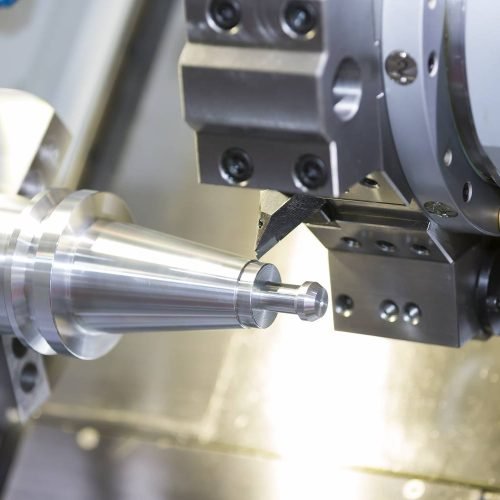
Operating from a 4,000 m² facility, Krsnaye delivers high-quality CNC turning services for customers in India and overseas. Our modern CNC turning equipment holds tight tolerances and produces smooth, consistent surface finishes. We can turn parts up to 435 inches in length and achieve ultra-precise tolerances of ±0.0002 inches (as required by the design).
Krsnaye machines a wide range of materials, including steel grades, cast iron, aluminium, copper, brass, and bronze, as well as engineering plastics such as nylon, acetal, PTFE, and fiberglass.
All materials can be supplied in ISO-compliant options, and material test reports can be provided on request. We machine from castings, bar stock, plates, and other raw forms, and we work in both metric and standard dimensions based on your requirements.
CNC Turning Machining Services in India
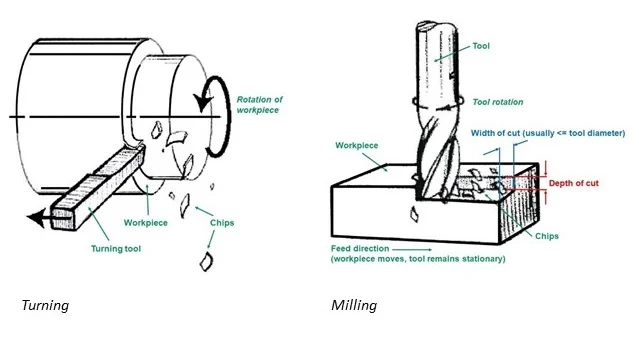
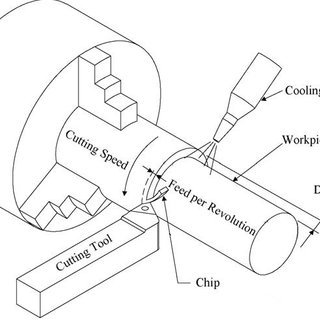
CNC turning is a machining process in which the workpiece rotates on a CNC lathe while a stationary cutting tool removes material to achieve the desired shape. The entire operation is controlled by computer-generated instructions, ensuring high precision, repeatability, and consistent quality.
CNC turning is one of the most fundamental and widely used machining methods, particularly suited for parts with rotational symmetry. It is commonly used to machine inner and outer cylindrical surfaces, conical surfaces, end faces, grooves, threads, and other rotational or formed geometries.
How CNC Turning Work?
CNC lathes are highly precise machines that operate through computer-controlled instructions. Understanding how the process works is essential for producing accurate, high-quality components. CNC turning follows a structured workflow to ensure consistency and precision throughout production.
The main steps involved in the CNC turning process include:
Manufacturability analysis
Evaluating the part design to confirm it can be efficiently and accurately machined.Process planning
Defining the machining route, including process segmentation, datum selection, machining sequence, and process integration.Process design
Selecting appropriate fixtures and cutting tools, determining tool paths, and setting cutting parameters such as speed, feed, and depth of cut.Process documentation
Preparing detailed machining instructions and technical documents to guide production.
What Types of Parts Are Suitable for CNC Turning?
High-precision components
CNC turning is ideal for parts requiring tight tolerances. With advanced CNC lathes, machining accuracy can reach tolerances as fine as ±0.001 mm, depending on the material and design.Complex geometries
Parts with intricate profiles or curved surfaces are well suited for CNC turning. CNC lathes use linear and circular interpolation to accurately machine complex shapes.Small to medium batch production
CNC turning is efficient for multi-variant production and small to medium lot sizes, offering flexibility without compromising consistency.High surface finish requirements
CNC turning can achieve smooth surface finishes, with surface roughness levels typically reaching Ra 6.3, making it suitable for parts where surface quality is critical.
Metals and Alloys We Specialize In
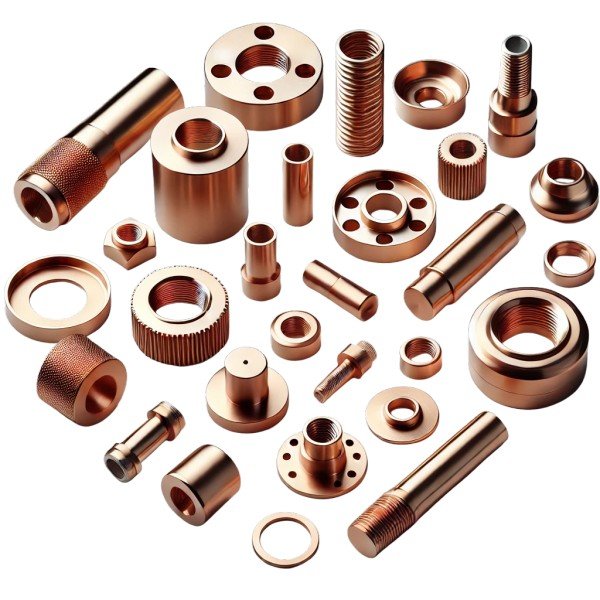
Copper
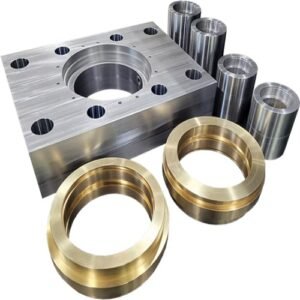
Carbon Steel & SS
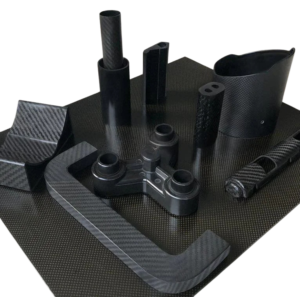
Carbon Fiber
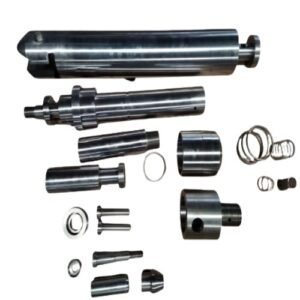
Aluminum
CNC Turning Applications
CNC machining is essential in aerospace manufacturing, bringing consistency and precision to highly standardized production processes. Aerospace components are made from a wide range of hard metals and specialized materials, covering applications from non-structural elements to mission-critical parts. CNC machining is particularly effective for difficult-to-machine materials such as Inconel, a nickel-chromium alloy engineered to perform under extreme temperatures and high stress.
Because of their size and mechanical complexity, agricultural components must be machined to strict technical standards. This includes tight tolerances, high dimensional accuracy, and the use of durable materials to ensure long-term performance in harsh operating conditions. Custom CNC machining plays a critical role in agricultural equipment manufacturing by delivering reliable, precision-made parts. Using CNC-machined agricultural components not only improves equipment durability but also enhances competitiveness in the market.
The flexibility, adaptability, and high machining precision of CNC lathe machining have long been recognized by automobile manufacturers. As early as the 1960s, CNC lathes began to be adopted for automotive parts production. By the 1990s, growing market competition and increasing demand for product variety pushed manufacturers toward flexible, multi-model production. To meet these diverse requirements, CNC machine tools became the core units of flexible manufacturing systems and were widely implemented across the automotive industry.
Structural components form the fundamental framework of electronic products. They provide fixation, support, protection, and visual structure for other functional parts. Depending on the operating environment, these components may also offer connectivity, shock resistance, heat dissipation, corrosion resistance, electromagnetic shielding, and anti-static performance.
Based on material selection, structural components are generally classified into metal and plastic parts. During the early stages of product development, CNC machining plays a critical role in producing both types. It enables rapid fabrication of functional and appearance prototypes, helping validate designs quickly and accelerate the overall product development process.
Since the introduction of the first CNC machine tool in the 1950s, CNC technology has evolved for more than half a century. Today, CNC machining is widely adopted across multiple manufacturing industries. It has significantly improved machining accuracy and production efficiency, shortened manufacturing cycles, enhanced working conditions, and reshaped product design and production methods within manufacturing enterprises.
As a highly efficient and precise digital machining technology, CNC machining has become the primary method for producing complex structural components in the medical device industry, where precision, consistency, and reliability are critical.
Modern CNC machines evolved from early manual machine tools developed over 200 years ago, originally used to produce standardized weapon components for the military in large batches. This legacy of precision manufacturing continues today, with the defense industry relying on CNC machining and turning for both prototyping and mass production.
Over time, many of these machining methods and components have transitioned into civilian applications. Innovations first developed for military use now play a vital role in industries such as aerospace, electronics, medical devices, and other high-precision manufacturing sectors.